



42 Creative Playdate Ideas That Aren't Boring (Indoor, Outdoor, by Age)
Your kid has a friend coming over in two hours, and you have no plan. The house is a mess, you're not sure what's in the pantry, and "just let them play" sounds great in theory. Until someone's bored ten minutes in and both kids are standing in the kitchen asking what they can do.
We've been there. So we put together 42 playdate ideas organized by age group and setting, from toddlers who still eat crayons to elementary schoolers who think they're too cool for everything (but secretly aren't). Every idea here is parent-tested, low-prep, and genuinely fun. Not the Pinterest-perfect kind of fun that requires a trip to three stores and an engineering degree.
If this is your very first time hosting, you might also want to check out our first playdate tips guide before diving in.
Need to actually invite a friend over first?
Make a free playdate invitation in about 30 seconds — pick a theme, type the details, text it or print it.
Make a Free InvitationPlaydate Ideas at a Glance
Jump to whatever you actually need:
- Toddler Playdate Ideas (Ages 2–3) — sensory, parallel play, short and sweet
- Preschool Playdate Ideas (Ages 4–5) — pretend play, simple cooperation
- Elementary Playdate Ideas (Ages 6–10) — challenges, projects, real games
- Indoor Playdate Ideas — rainy days and small spaces
- Outdoor Playdate Ideas — backyard, park, sidewalk
- Quick Games for Playdates — when you need something in five minutes
- How to Host a Playdate — logistics, snacks, etiquette
Toddler Playdate Ideas (Ages 2–3)
Toddler playdates are more about parallel play than deep collaboration at this stage of development. Keep things simple, sensory-rich, and short. Ninety minutes is the sweet spot. Any longer and you're tempting the meltdown gods.
1. Water Table Splash Zone
Fill a water table, a couple of plastic bins, or even a muffin tin with water and toss in cups, funnels, rubber ducks, and spoons. Toddlers will pour and splash for a surprisingly long time. Lay towels down if you're indoors, or just do this one outside and let everyone get soaked. That's half the fun.
2. Mega Block Building Party
Dump out every large block you own and let the toddlers go to town. At this age, they'll mostly build towers and knock them down (and knock down each other's towers, fair warning). The repetitive stacking and crashing is exactly the kind of cause-and-effect play their brains crave.
3. Sensory Bin Dig
Fill a large bin with dried rice, dried pasta, or kinetic sand. Bury small toys, animal figurines, or plastic letters inside and let the kids dig them out with scoops and spoons. This is one of those activities that buys you a solid 20 minutes of quiet focus. A miracle at this age. Sensory play supports fine motor skills and cognitive development in toddlers.

4. Dance Party Freeze
Put on a toddler-friendly playlist and let them dance. When you pause the music, everyone freezes. Toddlers are hilariously bad at freezing, which is what makes it entertaining for everyone. No supplies needed, works indoors or out, and it burns energy fast.
5. Sticker Collage
Give each kid a big sheet of paper and a pile of stickers. That's it. Toddlers are obsessed with peeling and sticking, and you'll end up with a piece of "art" they're genuinely proud of. Use large stickers with easy-peel backs so little fingers can manage independently.
6. Bubble Bonanza
Bubbles are the universal toddler crowd-pleaser. A bottle of bubble solution and a few wands are all you need. For extra magic, get a battery-powered bubble machine and let it run while the kids chase and pop. If you're indoors, do this in the bathtub or on a tile floor for easy cleanup.
7. Play Dough Squish Station
Set out play dough with cookie cutters, plastic knives, and rolling pins. Toddlers love squishing, poking, and cutting, and the tactile experience is great for fine motor development. Make your own with flour, salt, water, and food coloring if you want to skip store-bought.
8. Cardboard Box Fort
Save your delivery boxes. A few large cardboard boxes with doors and windows cut out become a fort, a castle, a spaceship, whatever their imagination decides. Hand over some crayons and let them decorate the walls. This costs nothing and toddlers will play in it for days after the playdate ends.
9. Animal Sound Safari
Scatter stuffed animals and plastic animal figurines around the room (or yard). Walk around together "discovering" each animal, making its sound, and talking about what it eats or where it lives. This is part scavenger hunt, part imaginative play, and toddlers eat it up, especially if you ham up the animal sounds.
10. Finger Painting Extravaganza
Tape large sheets of paper to the table or floor, squeeze out washable paint, and let the toddlers go hands-in. Smocks or old t-shirts are a must, and laying down a plastic tablecloth saves your sanity. The finished paintings make great playdate keepsakes. Roll them up and send one home with the guest.
Preschool Playdate Ideas (Ages 4–5)
Preschoolers are ready for more structure, more imagination, and more cooperation. They can follow simple rules, take turns (sometimes), and their pretend play is getting elaborate. These ideas lean into that growing independence while keeping prep minimal.
11. Obstacle Course
Use couch cushions, pool noodles, hula hoops, chairs to crawl under, and pillows to jump over. Build a course through the living room or backyard and time each kid with a kitchen timer. They'll want to run it over and over, tweaking it each time. Let them help redesign the course halfway through for extra engagement.
12. Treasure Hunt
Hide small toys, coins, or wrapped candies around the house or yard. Draw a simple map or give verbal clues like "check behind something you sit on." Preschoolers go absolutely wild for treasure hunts. The anticipation of finding something hidden is irresistible to them. Five minutes of hiding things buys you 30 minutes of searching.
13. Dress-Up Fashion Show
Pull out old Halloween costumes, oversized adult clothes, scarves, hats, sunglasses, and costume jewelry. Set up a "runway" (a hallway works perfectly) and let the kids dress up and strut. Play music for full effect. They'll create the most unhinged outfits imaginable, and the confidence boost of a little audience is priceless.
14. Baking Together
Simple recipes like cookies, muffins, or Rice Krispie treats are perfect for preschoolers. They can stir, pour, and decorate. Yes, it will be messy. Yes, the cookies will look like abstract art. No, they won't care. Eating what they made together is the highlight. Bonus: you've solved the playdate snack question.
15. Blanket Fort Movie Time
Drape blankets over chairs and the couch to build a fort. Toss in pillows, flashlights, and a tablet or laptop with a short movie or a few episodes of a show both kids enjoy. Add popcorn and juice boxes and you've created an experience that feels way more special than just "watching TV." Keep it to 20–30 minutes so the playdate doesn't become pure screen time.
16. Nature Scavenger Hunt
Make a simple list with pictures: a red leaf, a smooth rock, a feather, something that smells good, a stick shaped like a letter. Head to the backyard or a nearby park and let the kids collect their finds in a paper bag. This works year-round. Just adjust the list for the season. It sneaks in observation skills without feeling educational.
17. Car Wash Station
Fill buckets with soapy water and let preschoolers "wash" their toy cars, bikes, or ride-ons. Add sponges, old toothbrushes for scrubbing, and towels for drying. It's water play with a purpose, and they take it seriously. Best done outside on a warm day. Everyone ends up wetter than the toys.
18. Doctor or Vet Clinic
Set up a pretend clinic with stuffed animals as patients. A toy doctor kit, bandages, and a notepad for "prescriptions" turn this into an elaborate game. One kid plays doctor, the other brings in their sick teddy bear. They'll diagnose everything from "broken paws" to "too many cookies syndrome." Imaginative play at its best.
19. Color Mixing Science
Give each kid cups of water and a few drops of food coloring in red, blue, and yellow. Let them mix colors using eyedroppers or spoons and discover what happens. "I made purple!" never gets old at this age. It feels like a science experiment, which makes preschoolers feel very important and grown-up.
20. Pizza Party (Make Your Own)
Buy pre-made pizza dough or use English muffins as individual crusts. Set out bowls of sauce, cheese, and toppings and let each kid build their own pizza. Pop them in the oven and eat together. The pride of eating a pizza they assembled themselves is worth the flour on your floor.
21. Puppet Show
Use sock puppets, paper bag puppets, or stuffed animals to put on a show. Drape a blanket over the back of a couch for a "stage." One kid performs while the other watches, then they switch. Don't expect a coherent plot. The shows are usually wonderfully chaotic and full of sound effects. That's the charm.
22. Bug Hunt
Arm the kids with magnifying glasses and a container (with air holes) and head outside to find bugs. Ants, roly-polies, worms, ladybugs. Preschoolers are fascinated by all of them. Look under rocks, near plants, and along the edges of the house. Talk about what each bug does and then release them back. It's free, it's outside, and it's endlessly captivating for this age.
Elementary Playdate Ideas (Ages 6–10)
Elementary-age kids want independence, challenge, and the feeling that they're doing something cool. They can handle more complex activities, longer attention spans, and actual cooperation (most of the time). These ideas let them take the lead while keeping things fun enough that nobody asks for a screen.
Looking specifically for ideas for 6, 7, 8, or 10 year olds? We have a dedicated guide with 20+ activities pitched just for older kids, including the ones who insist they're "too old" for anything: Playdate Ideas for Older Kids →
23. Backyard Camping
The American Academy of Pediatrics encourages outdoor, unstructured play as a counterbalance to screen time, and this one delivers. Set up a tent in the backyard (or build one with tarps and poles). Add sleeping bags, flashlights, and a bag of trail mix. Even if nobody actually sleeps outside, the tent becomes a base camp for all kinds of imaginative play. Tell a round-robin story where each kid adds a sentence. On a warm evening, this can stretch into a longer playdate that feels like an adventure.

24. LEGO Build Challenge
Set a timer for 15 minutes and give each kid the same pile of random LEGO bricks. Challenge them to build the tallest tower, the best vehicle, or the weirdest creature. Compare creations when time's up. No winners, just appreciation for each other's builds. This taps into both creativity and the competitive streak that kicks in around age 6.
25. Sidewalk Chalk Art Gallery
Give the kids a bucket of sidewalk chalk and a section of driveway or sidewalk. Challenge them to create a mural, a comic strip, or a hopscotch course. The scale is what makes this different from regular drawing. They can go big, trace each other's outlines, or create a whole chalk "neighborhood." The art washes away with rain, which somehow makes it more fun, not less.
26. Science Experiments
Simple experiments like baking soda volcanoes, Mentos in Diet Coke, slime-making, or building a bridge out of popsicle sticks hit the sweet spot between education and entertainment. Look up one or two experiments before the playdate so you have supplies ready. The "whoa" factor keeps kids engaged, and they'll tell every adult they see about what happened.
27. Board Game Tournament
Pull out two or three age-appropriate board games and play a mini tournament. Games like Sorry, Uno, Connect 4, Guess Who, or Ticket to Ride Junior work well. Rotating through games keeps things fresh, and the structured turn-taking is a welcome break from free play chaos. Have a small prize for the overall winner if you want to raise the stakes. Even a sticker works.
28. Sports Day
Set up stations in the yard: relay races, three-legged races, egg-and-spoon races, long jump, and a simple throwing game. A whistle and a stopwatch (your phone) are all you need to make it feel official. Kids this age love competition, and rotating through events keeps everyone moving. Works best with three or more kids, so consider inviting a third friend.
29. DIY Craft Project
Pick a specific craft with a tangible result: friendship bracelets, painted rocks, tie-dye t-shirts (outside!), or building birdhouses from kits. Having a finished product to take home makes this feel special. Gather supplies ahead of time and lay everything out on a covered table. The crafting conversation is often the best part. Kids open up when their hands are busy.
30. Scavenger Hunt with Clues
Write a series of clues where each one leads to the next location and the final clue leads to a small prize (candy, a small toy, or a special snack). Hide the clues around the house or yard. This takes about 15 minutes to set up and provides 30+ minutes of excitement. For older kids in the group, make the clues into riddles to up the difficulty.
31. Cooking Competition
Give the kids a set of ingredients and challenge them to create the best snack, sandwich, or dessert. You judge the results on taste, creativity, and presentation. It's basically a kid-friendly cooking show. Set ground rules about which kitchen tools they can use (no stove for younger kids), and embrace the chaos. The results are usually surprisingly edible.
32. Comic Book Creation
Give each kid folded paper, markers, and colored pencils, and challenge them to create their own comic book. They'll need a hero, a villain, and a problem to solve. Elementary kids get deeply into this. Don't be surprised if the playdate ends and they're asking for "just five more minutes" to finish their story. Share the comics out loud at the end for maximum laughs.
33. Nerf Battle or Water Gun War
Nerf guns in winter, water guns in summer. Set up barriers with outdoor furniture or cardboard boxes, establish a few ground rules (no face shots, boundaries of the play area), and let them go. This is high-energy, high-laughter, and solves the "what do we do" question for a solid hour. Have towels and dry clothes ready for water gun days.
34. Garden Planting
Give each kid a small pot, some soil, and seeds. Sunflower seeds are great because they grow fast and tall. Let them plant, water, and decorate their pot with paint or stickers. They take their pot home and watch it grow over the coming weeks, which extends the playdate memory long after it's over. This is a calm, grounding activity that pairs well with a high-energy game before or after.
35. Movie-Making
Hand the kids a phone or tablet and let them write, direct, and star in a short movie. They'll need to come up with a plot, assign roles, find "costumes" and props around the house, and film their scenes. The planning process is half the fun. Watch the finished movie together with popcorn at the end. Fair warning: they'll want to make a sequel.
Indoor Playdate Ideas
Some days it's raining. Some days it's 95 degrees. Some days the kid just doesn't want to leave the couch. Indoor playdates are their own art form, and a few of the ideas above shine especially well inside: the obstacle course (#11), blanket fort movie time (#15), LEGO build challenge (#24), and board game tournament (#27) all work without a square foot of grass.
For a deeper list aimed at rainy-day, stuck-inside playdates — including quieter art and building projects that don't destroy your living room — see our full indoor playdate ideas guide.
36. Pillow Fort + Glow Stick Reading Nook
Drape blankets over chairs and the couch, drop in pillows, and break out a pack of glow sticks. Add a stack of picture books or chapter books and let the kids read to each other in the soft glow. This is the calm, low-stakes activity that quietly resets the energy when things have been wild for an hour. Works for every age from preschool up. Older kids will turn it into a hideout for whispered conversations, which is exactly the point.
37. Floor-Is-Lava Course
The rules are exactly what they sound like. Scatter couch cushions, pillows, and folded blankets across the floor as "safe islands." The carpet is lava. Kids have to get from one end of the room to the other without touching the floor. Add a timer for older kids. Add a rescue mission (save a stuffed animal stranded in the middle) for younger ones. Costs nothing, uses what you already own, works in any size living room.
38. Drawing Telephone
Like the classic whisper game, but on paper. Each kid writes a short phrase at the top of a sheet ("a dinosaur eating spaghetti"). They pass it. The next kid draws it, folds the paper to hide the phrase, and passes again. The next kid writes a new phrase based on the drawing. By round five, "a dinosaur eating spaghetti" has become "a robot crying in the rain." Hilarious for elementary kids, and pretty engaging for preschoolers who can be paired with an adult.
Outdoor Playdate Ideas
Outdoor playdates are easier on your house, easier on your nervous system, and the kids tend to come home tireder. Many ideas above are outdoor-friendly: the nature scavenger hunt (#16), sidewalk chalk gallery (#25), sports day (#28), and water gun war (#33) all live outside.
39. Backyard Olympics
Pick five made-up events: long jump off a chalk line, balloon toss, hula hoop hold, slowest race (no walking, no stopping), and a beanbag throw into a bucket. Make medals out of cardboard and yarn. Open with a torch ceremony (a flashlight works). Close with a podium. Kids age 5 to 10 will buy in completely if you commit to the bit. The ridiculous events are the funniest, so keep at least two of them weird.
40. DIY Smoothie Bar
Set out bowls of pre-cut fruit (strawberries, bananas, blueberries, mango), a tub of yogurt, juice or milk, ice, and a blender on the patio. Let each kid invent their own smoothie and give it a name. "Tornado Banana." "Pink Slime." "Dragon Fuel." They taste their own creations, and usually each other's, and the worst combinations are the most memorable. Pairs well with a backyard game right after.
Quick Games for Playdates
When you need something right now — the kids are restless, the next activity isn't ready, or someone just asked "what do we do" for the third time — these are the five-minute pickups. Most need zero prep and no supplies.
41. Spy Training Academy
Run a string of yarn across a hallway in a crisscross pattern to make "laser beams." Kids have to climb through without touching any string. Add a secret code (just three made-up words they have to memorize), a code-breaking puzzle on a napkin, and a final mission ("retrieve the golden marker from the kitchen without being seen"). Works for one kid solo or a pair. Most parents are amazed how seriously a 7-year-old takes the laser-beam phase.
42. Build-Your-Own Pizza Bagel Bar
When you need a snack and an activity in the same move: split bagels in half, put out a bowl of pizza sauce, shredded cheese, pepperoni, olives, and whatever else is in the fridge. Each kid builds their own. Three minutes in the toaster oven. Eat at the counter. Low effort, low mess, and it doubles as the snack you forgot to plan. Pair with one of the fun things to do on a playdate right after so the kids don't immediately ask what's next.
How to Host a Playdate
The activity is only half of it. The other half is the small stuff parents forget to figure out until it's awkward — pickup time, allergies, whether the other parent is staying, where the bathroom is. None of it is hard, but none of it happens by accident either.
The short version: confirm the basics over text before the playdate (drop-off and pickup, allergies, contact number, whether the visiting parent is staying), have one planned activity ready plus a snack, and don't over-program. Two hours is plenty for most ages.
For the longer version, three companion guides cover the parts that come up most:
- First playdate tips — what to do when it's brand-new and you don't know the other family yet
- What to bring to a playdate — host and guest checklists, so nobody arrives empty-handed or unprepared
- Playdate etiquette — the unwritten rules around invites, thank-yous, reciprocating, and gently declining
Tips for a Successful Playdate
Great playdate ideas are only part of the equation. A few practical things make the difference between "that was fun" and "never again."
Match Duration to Age
For toddlers (ages 2–3), keep playdates to 60–90 minutes. Preschoolers (ages 4–5) can handle about two hours. Elementary kids (ages 6–10) are good for two to three hours, and older kids in that range can do half-day or even full-day playdates comfortably. When in doubt, shorter is better. End on a high note rather than waiting for a meltdown.
Have Snacks Ready
Hungry kids are cranky kids. Have a simple snack ready for midway through. Fruit, crackers, cheese, pretzels, or popcorn. Always ask the visiting parent about allergies before the playdate. For more ideas, check out our playdate snack ideas guide.
Set Screen Time Expectations
Some screen time during a playdate is fine, especially a blanket fort movie or a cooperative video game. But defaulting to screens for the entire visit defeats the purpose. The AAP's screen time guidelines recommend prioritizing interactive, non-screen activities for young children. Use screens as one activity among several, not the main event. If the visiting child's parent has strong feelings about screen time, respect their boundaries.
Communicate with the Other Parent
Before the playdate, exchange the basics: drop-off and pickup time, any allergies or dietary restrictions, comfort with water play or outdoor activities, and whether the visiting parent is staying or leaving. A quick text covering these points avoids awkward moments later. If it's a first playdate with a new family, the visiting parent may prefer to stay, and that's perfectly fine. Understanding playdate etiquette helps both families feel comfortable from the start.
Two small tools take the friction out of all this: send a playdate invite with the date, time, and place already filled in, and make playdate calling cards so your kid can swap numbers with new friends at the park without you scrambling for a pen.
Have a Backup Plan
Sometimes an activity just doesn't land. The kids aren't into it, someone gets frustrated, or the weather changes. Have one or two backup ideas in your pocket. A simple "Hey, let's do something different!" keeps the energy up. The ideas in this list are interchangeable within age groups, so pick two or three for any given playdate.
Don't Over-Schedule
It's tempting to plan every minute, but kids need unstructured time too. Have one planned activity and let the rest be free play. Some of the best playdate moments happen when kids invent their own games. You just set the stage. They'll take it from there.
Make Playdates Happen More Often
The hardest part of a playdate isn't the activity. It's the logistics. Exchanging numbers at school pickup, texting to set a date, confirming who's bringing what. It starts with a connection, and connections start with making yourself easy to reach.
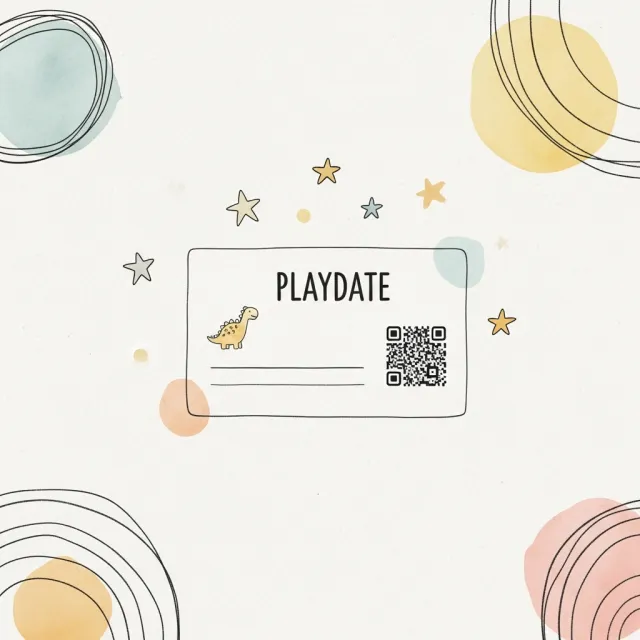
That's why we built free playdate cards. They're simple printed cards with your child's name, your contact info, and a QR code. So the next time your kid hits it off with someone at the park, you can hand their parent a card and say, "Text me, let's set something up." No fumbling for phones, no forgotten names, no missed connections.
Create your free playdate card and start turning "we should do a playdate sometime" into actual plans on the calendar.
Sources
Guidance in this article draws on the following authoritative resources.
- Centers for Disease Control and Prevention. “Healthy Habits for Child Development.” cdc.gov
- American Academy of Pediatrics (HealthyChildren.org). “Sensory Integration Therapy.” healthychildren.org
- American Academy of Pediatrics. “Media and Children.” aap.org
- American Academy of Pediatrics. “Media and Young Minds.” publications.aap.org
Keep Reading
What Is a Playdate? Meaning, Ages & How to Plan One
What a playdate actually is, how it works, and why it matters for your child's social development. A no-nonsense guide for parents.
Playdate Etiquette: How Long, Drop-Off & the Do's and Don'ts
How long should a playdate last, do you stay or drop off, and what to ask first — a simple playdate etiquette guide for parents, by your kid's age.
Your Child's First Playdate: Tips, What to Expect & Ideas
Everything for your child's first playdate — how to pick the right friend, what to expect, how long to stay, and calming first-time nerves.
The Complete Guide to Preschool Playdates (Ages 3-5)
Navigating preschool playdates for the first time? Learn age-appropriate activities, duration, and how to connect with other parents.